 | Up to |  | Home |  | Humour |  | Language |
 | Site Map | | |  | Text version |
|
|
 Curious
Words
and
Phrases
Curious
Words
and
Phrases[accolent] [adjunctory] [affine] [ailurophile] [aleatory] [alexipharmacon] [ambisinister] [ancilla] [anent] [apiphobe] [aposiopesis] [arachibutyrophobia] [ballistophobia] [betenoire] [bosky] [brockie] [cag] [carnyx] [chatoyance] [cnidophobe] [commensal] [crytoscopophilia] [cynophobe] [dudder] [enology] [exsanguinate] [famulus] [fewterer] [fictile] [fid] [fliegel] [fremitus] [frenchleave] [fribble] [gilravage] [girn] [glabrous] [glaucous] [glout] [gloze] [haypth] [kitthougue] [leechdom] [leucoderm] [lexiphane] [lucubration] [macadamise] [mattoid] [melissophobe] [misodoctakleidist] [misopedist] [morepork] [mulct] [muliebrity] [myoclonic] [nafrage] [nafragous] [nares] [nebbish] [network] [oenology] [omphaloskepsis] [otophobia] [parasang] [paronomania] [paronomasia] [pawl] [peccatophobia] [persiflage] [phaneromaniac] [phatic] [philargyist] [philocynic] [pococurante] [properispomenon] [punkah] [scobberlotch] [scrobiculate] [scrod] [septentrional] [siege] [sinistral] [sitophobia] [slobberchops] [snottygobble] [spheksophobe] [spong] [squinch] [sternutation] [swinge] [taphephobia] [trichophobia] [ucalegon] [ugsome] [usquebae] [velleity] [vestiphobia] [wimbler] [xanthoderm]
| See also: |
|
"There are many similar examples of common names being applied to disparate plants or plant groups. One is snotty-gobble (the parasite Cassytha [filiformis] in South Australia, Persoonia saccata in Western Australia)."
-- from "A rose by any other name ... the changing names of plants" at the sadly defunct State Herbarium of South Australia web site.
-- Professor Roly Sussex in an interview "The Naming of Weeds"
1964 Courier-Mail (Brisbane, Australia) 21 Dec., The policeman asked Godfrey Booth: `Your occupation, sir?' Mr. Booth..replied `Cag handed straw wimbler.'
-- from OED News, Series 2, No. 7, January 1998 - see Fun_People Archive 17 Feb 1998 ; original URL: http://www1.oup.co.uk/reference/newoed/jan-1998.html
ancilla : The sidekick who helps another to accomplish or master something difficult or complicated. A loyal, trusted aide for whatever task is at hand, from learning Japanese in one month to building a Transylvanian android to just defeating the bad guys. An ancilla can also be called an adjunctory. A trusted assistant to a magician, incidentally, is a famulus. affine : An in-law, or any relative whom through mere marriage you have acquired, earned, valued or put up with. Announcing that your affines are coming this weekend will impress other people that you're expecting an important delivery. bête noire : That particular dreaded or detested or feared person (literally, "black beast") to be at all costs avoided, to whom one is perversely averse. An old rival? An aggravating pest? An ex-husband? Whichever, your bugbear and pet hate as a human or subhuman being. brockie : Anybody with a dirty face (and a word borrowed truly from the barnyard, where it means a cow with a black-and-white face). Brockies include smudged people working on the undersides of cars, housewives on cleaning day, gardeners on rainy days, and children left to themselves for more than a half-hour. cnidophobe : The person whose grand terror is of being stung, as by a bee or a wasp. Picnicking or summer-strolling cnidophobes tend to overreact to airborne insects, jumping up at the sound of a distant, droning airplane or swinging wildly at a stray dogwood petal that grazes the cheek. More specifically, one who fears bees is an apiphobe or melissophobe, and the fearer of wasps is a spheksophobe. All cnidophobes have their ears cocked for bombination (buzzing or droning). cynophobe : The dog-fearer or hater, and not just the mailman and milkman. The avoider of canines knows that their bite is even worse than their bark, not to mention the shedding and drool of certain breeds, the yelping and neuroses of certain other breeds, and the big or small do made on sidewalks by all breeds. To say nothing of the cold sweat induced by the sight of a Doberman or German shepherd or the ineffable odor of a heavily rained-on dog. mattoid : Nobody is ever partly pregnant, but what about being semi-insane? If you know an unhinged genius, borderline psychopath, quirky monomaniac, extreme eccentric, deranged philosopher or restless crank, you know a mattoid. The mattoid is not quite around the bend but always has the turn signal switched on. From an Italian word for "insane". misodoctakleidist : The piano student who just hates to practice. How many millions of misodoctakleidists have suffered from their key aversions? How many, hard-pedaled by parents into learning the piano, have felt that sitting down to practice octaves and études is like pulling a chair up to a meal of cold dominoes and graph paper? Practice makes perfect, and makes misodoctakleidists, too. misopedist : The hater of children. When the baby is trundled out to coo, the misopedist sees not an infant but a stubby little flesh-coloured homonculus (grotesque little creature). He or she does not enjoy passing school-yards, visiting couples who have a brood of brats, or answering the door on Halloween. To paraphrase W. C. Fields: "Anybody who is a misopedist and a cynophobe can't be all bad." nebbish : A haplessly, sadly unfortunate and innocuous being, kind of a cross between a poor soul and a sad sack. Along with schlemiel and schlimazl (and the similar Yiddish words schlump, zhlub, schnook, schmendrick, schmo, nayfish, yutz ...), a jerk. As Leo Rosten explains, the schlemiel trips and knocks down the schlimazl, and the nebbish repairs the schlimazl's glasses. philargyist : One who loves money, or who is nummamorous or lucrepitous. Estimates vary, but there is general agreement that the portion of our planet not covered by water or ice is covered largely by philargyists. Philargyists are otherwise known as mammonists, chrematists, philoplutaries, aphnologists and plutolators. The money lover who is driven by a fear of poverty is a peniaphobe. philocynic : A dog lover. The world is pretty much divided into philocynics and ailurophiles, the kitty lovers. A dog keeper, especially someone who looks after greyhounds, is called a fewterer. phaneromaniac : The picky person - picking compulsively at scabs or pimples or ears, scratching the scalp, or fingernailing possible wildlife on his or her own person. Most people do not enjoy watching skin-frisking phaneromaniacs in action, never knowing, or wanting to, what they'll come up with in their nervous self-scavanging. pococurante : The incredibly indifferent, careless or nonchalant person, a rolling stone who is less devil-may-care than never-may-care. (The word, from Italian, means "caring little"). The pococurante is gallionic - interested in little, bored with much and fazed by nothing - and might be considered cool if he or she weren't so uninteresting and aimless. Also known as a Laodicean, a word derived from an ancient Phrygian city noted for its lukewarm inhabitants. When two pococurantes get together to argue, they have a shrugfest. sinistral : A left-handed person, or one who is afflicted with what is very infrequently known as mancinism (as opposed to dexterity, which means right-handedness). "Sinistral" could well be a word, like "mistral", for a mean wind, and indeed major-league managers look annually for hard-throwing sinistrals to add to the bullpen. Another word for sinistral is kitthougue. A person who is clumsy with both hands is ambisinister. A sleight-of-hand artist, or prestidigitator, is a chirosophist. Ucalegon : A Ucalegon is a neighbour whose house is on fire. It seems impossible that there should be a word for this, but here you are (courtesy of Trojan legend, in which Ucalegon was an unfortunate, burned-out neighbour of Aeneas). An extremely rare word, though one should not be burning to have a chance to use it. A mere neighbour, whose house may or may not be in flames, is an accolent. xanthoderm : A yellow-skinned person, or a lutescent (yellowish) individual whose race is Oriental. This is not a euphonious word, but then (not to be too jaundiced) neither are some for people whose hue is black (a melano or melanoderm), white (a leucoderm) or red (the aithochroi). Caucasians who have pale skin and dark hair are melanochroi. |
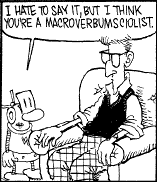 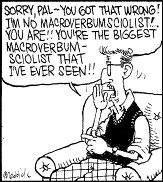  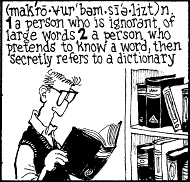 -- Robotman -- |
"... Mr Zoliparia, who being an important old gent of some note, has got one of the prime positions in all the town for his apartments, viz the right eyeball of the septentrional gargoyle Rosbrith. The gargoyle Rosbrith looks out to the north ..." -- from Feersum Endjinn by Ian M. Banks.
Apparently
derived
from
Latin
septentriones
(septem
-
"seven"
and
triones
-
"ploughing
oxen"),
referring
to
seven
principal
stars
in
either
of
the
constellations
Ursa
Major
(big
dipper)
or
Ursa
Minor
(little
dipper)].
scrod : a young fish (as a cod or haddock); especially : one split and boned for cooking
Joke heard via Raf:
A friend reports that he was in a Boston taxi last week, and because he'd heard about all the great seafood available in the area, he asked the cabbie, "Say, where can I get scrod around here?"The cabbie laughed and said, "I've been asked that question a thousand times, but never in the pluperfect subjunctive."
This variant occured at www.total.net/~prems/Jokes.html [page defunct Jan 2002]:
A businessman arriving in Boston for a convention found that his first evening was free, and he decided to go find a good seafood restaurant that served Scrod, a Massachusetts specialty. Getting into a taxi, he asked the cab driver, "Do you know where I can get Scrod around here?" "Sure," said the cabdriver. "I know a few places... but I can tell you it's not often I hear someone use the third-person pluperfect indicative anymore!"
Compare this with a posting on the newsgroup sci.lang.translation:
Newsgroups: sci.lang.translation
Subject: Re: ?? strung-out mother ??
>>ps - and I apologize for any vulgar language in advance, but could someone
>>clue me in as to what the word "skank" means in American English
>
>It's obviously the past participle of 'skunk'. (;-)
Which is the simple past of "skink"?
... and from the newsgroup alt.religion.scientology:
[...] Just a minute now! Everyone knows that 'skank' is the past tense of 'skunk', just as 'wank' the the past tense of, er, .. Well anyway, [...]
From http://luc.aleaume.free.fr/new_site/site_fortune/html/definitions.html:
From the book Language Change: Progress or Decay? by Jean Aitchison (1981):
From Webster's dictionary:
From the wonderful Merriam-Webster Word for the Wise site:
From the Lewis & Short Latin Dictionary:
From the dictionary.com word-of-the-day archive:
From Mother Tongue by Bill Bryson (1990):
Some of these words deserve to be better known. Take velleity, which describes a mild desire, a wish or urge too mild to lead to action. Doesn't that seem a useful term? [...] Or ugsome, a late medieval word meaning loathsome or disgusting. [...] Our dictionaries are full of such words -- words describing the most specific of conditions, the most improbable of contingencies, the most arcane of distinctions.
And yet there are odd gaps. We have no word for coolness corresponding to warmth. We are strangely lacking in middling terms -- words to describe with some precision the middle ground between hard and soft, near and far, big and little. We have a possessive impersonal its to place alongside his, hers, and their, but no equivalent impersonal pronoun to contrast with the personal whose. Thus we have to rely on inelegant constructions such as "the house whose roof" or resort to periphrasis. Ruthless was once companioned by ruth, meaning compassion. [...] But, as with many such words, one form died and another lived. Why this should be is beyond explanation. Why should we have lost demit (send away) but saved commit? Why should impede have survived while the once equally common and seemingly just as useful expede expired? No one can say.
[...] It has been said that English is unique in possessing a synonym for each level of our culture: popular, literary, and scholarly -- so that we can, according to our background and cerebral attainments, rise, mount, or ascend a stairway, shrink in fear, terror, or trepidation, and think, ponder, or cogitate upon a problem. This abundance in terms is often cited as a virtue. And yet a critic could equally argue that English is an untidy and acquisitive lanugage, cluttered with a plethora of needless words. After all, do we really need fictile as a synonym for mouldable, glabrous for hairless, sternutation for sneezing? Jules Feiffer once drew a strip cartoon in which the down-at-heel character observed that first he was called poor, then needy, then deprived, then underprivileged, and then disadvantaged, and concluded that although he still didn't have a dime he sure had acquired a fine vocabulary.
[p. 60-62]
Morepork is the name of two species of owl found in Australian & New Zealand, known variously as the boobook, mopoke, morepork (from the sound of its double hoot), spotted owl & marbled owl (from its appearance). I'd found a homophone in Terry Pratchet's famous Discworld novels, which feature the city Ankh-Morpork [thanks to Geoff Bailey for the correct spelling!], but it wasn't until almost 20 years later I came across 'morepork' in Ruth Park's novel (see quote below), originally published in 1948. A brief web search turned up the following:
Terry [Pratchett] has said that the name 'Ankh-Morpork' was inspired neither by the ankh (the Egyptian cross with the closed loop on top), nor by the Australian or New Zealand species of bird (frogmouths and small brown owls, respectively) that go by the name of 'Morepork'.
From The Harp in the South by Ruth Park (Published in Ruth Park's "Harp in the South" Novels, Penguin Books, 1987):
"Sure, I'd look like a house in red," protested Mumma, secretly pleased that he had suggested such a bold and flashing colour. "Black's right for stout people."
"Not black," cried Hughie. "I won't have my wife looking like a morepork's widow." This pleased him, and he lay there chuckling for some minutes, repeating "morepork's widow". [...]
[Chapter 16, p. 357-358]
From assorted sources on the internet:
Note: 2004-01-29 Thanks to Elaine Morgan for supplying the following information:
Paronomania is actually an invention by Reginald Hill in his book Dialogues of the Dead - on the inside front cover of the book you should see that he states this word is made up!!!!That is not quite what Hill said -- see the note below.
Note: 2004-11-15 I obtained a copy of Dialogues of the Dead. In fact, Hill simply quotes the entry for paronomania from the Oxford English Dictionary, 2nd edition. The entry begins:
paronomania [...] Factitious word derived from a conflation of PARONOMASIA [...] Word-play + MANIA [...]The entry goes on to provide a second definition - the proprietary name of a board game which sounds similar to scrabble.1. A clinical obsession with word games [... 3 quotes provided dating from the years 1760, 1823 and 1927]
fliegel -- From The Comic Stories by Anton Chekhov (Translated by Harvey Pitcher, pub. Ivan R. Dee, Chicago, 1999):
Words found in The World of Jeeves by P. G. Wodehouse:
"I can't face a breach of promise action with a crowded court giving me the horse's laugh and the jury mulcting ... Is it mulcting?"
"Yes, sir, you are quite correct."
"And the jury mulcting me in heavy damages. I wouldn't be able to show my face in the Drones again."
[From Jeeves and the Greasy Bird]
The Paddock, Beckley-on-the-Moor, was about a couple of parasangs from the village [...]
[From Without the Option]
From The Admirable Crichton, by J. M. Barrie (University of London Press, 1970):
punkah (n.) portable fan usually of leaf or palmyra; large swinging cloth fan on frame worked by cord or electrically. From Hindi pankha fan, from Sanskrit paksaka (paksa wing). [The Concise Oxford Dictionary, 7th Edition]
commensal adj. & n. (one) who eats at the same table; (animal or plant) living harmlessly with or in another and thus obtaining food [...] [Latin mensa table] -- The Concise Oxford Dictionary, 7th Edition
From The Story of Rats by S. Anthony Barnett (Allen & Unwin, 2001):
[Chapter 3, p. 42]
From Some cloves of Gallic for the alphabet soup, one of Ruth Wajnryb's weekly word columns (Sydney Morning Herald, 20 Sep 2003, Spectrum liftout, p. 9)
Things Gallic take up quite some space in the dictionary. In the Collins, for example, between "fremitus" (the vibration felt when the hand is placed on the chest of a coughing patient) and "frenetic" (the state in which I arrived at the dictionary), there are 54 entries (60 in the Macquarie) related to phenomena attributable to the French.
From Made In America by Bill Bryson (Black Swan books, 1994):
[Chapter 2, Becoming Americans, p. 25]
fid n. a tapered usually wooden pin used in opening the strands of a rope
pawl n. A pivoted tongue or sliding bolt on one part of a machine that is adapted to fall into notches on another part (as a ratchet wheel) so as to permit motion in only one direction [Merriam-Webster]
From The Many-Coloured Land by Julian May (Pan Books, 1981):
He used the tough glassy needle of a leatherworking fid to probe the slot where the brass latchbar came through until he was able to lift a concealed pawl that was preventing the notched bar from moving. [...]
[From Part II "The Initiation", Chapter 4, p. 137]
chatoyance n. The quality or state of being chatoyant --
chatoyant adj. Having a changeable luster or color with an undulating narrow band of white light [Etymology: from the French present participle of chatoyer to shine like a cat's eyes] [Merriam-Webster]
From The Many-Coloured Land by Julian May (Pan Books, 1981):
[From Part III, "The Alliance", Chapter 2, p. 296]
enology / oenology n. the science of wine and wine-making.
From The Many-Coloured Land by Julian May (Pan Books, 1981):
[From Part III, "The Alliance", Chapter 3, p. 308]
bosky adj. having an abundance of trees or shrubs / relating to woods
From The Many-Coloured Land by Julian May (Pan Books, 1981):
[From Part III, "The Alliance", Chapter 5, p. 328]
carnyx adj. an ancient Celtic or Pictish war horn
From The Many-Coloured Land by Julian May (Pan Books, 1981):
[From Part III, "The Alliance", Chapter 11, p. 384]
scrobiculate adj. (Botany & Zoology) pitted, furrowed. [from Latin scrobiculus (scrobis trench [...] )] -- The Concise Oxford Dictionary, 7th Edition
From Intervention by Julian May (Pan Books, 1988):
[From Part I, "The Surveillance", Chapter 2, p. 21]
usquebae n. Earlier form of the word whisky. The Concise Oxford Dictionary, 7th Edition cites whisky as an abbreviation of the obsolete whiskybae, a variant of usquebaugh. See also the entry for usquebae in The Dictionary of the Scots Language
gilravage
v.
1.
To
eat
and
drink
intemperately,
to
guzzle,
to
feast
riotously,
to
indulge
in
high
living;
to
act
extravagantly
in
any
way.
Fig.
to
gloat,
to
feast
one's
mind.
2.
To
romp,
to
indulge
in
noisy
merry-making,
to
create
a
noisy
disturbance.
From Intervention by Julian May (Pan Books, 1988):
Nobody took it amiss. Usquebalian dejection is no novelty in an Edinburgh pub. The musical gilravagers directed their attentions elsewhere [...]
[From Part II, "The Disclosure", Chapter 18, p. 337]
anent prep. concerning (archaic, jocular or Scottish) -- The Concise Oxford Dictionary, 7th Edition. See also: the Wordsmith.org entry for anent
From Diamond Mask by Julian May (Pan Books, 1994):
[Chapter 20, p. 376]
[Note 2004-10-14 -- the word anent is alive and well in modern Scotland. See this Scots version of a document for examples.]
aleatory adj. 1. depending on an uncertain event or contigency as to both profit and loss (an aleatory contract) 2. relating to luck and especially bad luck -- [Merriam-Webster]
From Perseus Spur by Julian May (Voyager [HarperCollins], 1998):
"Not a one," Mimo said. "I put us on an aleatory course for the first few hundred light-years and did repeated scans as we zigged and zagged. Nobody chased us [...]"
[Chapter 12, p. 146]
macadamise v. to construct or finish (a road) by compacting into a solid mass a layer of small broken stone on a convex well-drained roadbed and using a binder (as cement or asphalt) for the mass [From noun 'macadam', from John L. McAdam, died 1836, British engineer] -- [Merriam-Webster]
From The North London Book of the Dead by Will Self:
From The Curse of Chalion by Lois McMaster Bujold (Voyager [imprint of Harper Collins], London 2002):
phatic adj. of, relating to, or being speech used for social or emotive purposes rather than for communicating information -- [Merriam-Webster] ; denoting speech as a means of sharing feelings or establishing sociability rather than for the communication of information and ideas -- [Hutchinson Encylopaedia]
From The Algebraist by Iain M. Banks (Orbit 2004)
"Good morning, Seer Taak."
"And how are our gardens?"
"Generally healthy, I would say. In good shape for spring." I could have gone on to provide much more detail, naturally, but waited to discover whether Seer Taak was merely indulging in phatic discourse. [...] [Prologue, p. 3]
siege n. (archaic sense) throne
From Esther Friesner (editor), The Chick is in the Mail (Baen Books, 2000):
squinch n. a support (as an arch, lintel, or corbeling) carried across the corner of a room under a superimposed mass [derived from an alteration the earlier word scunch meaning back part of the side of an opening].
nares n. the pair of openings of the nose or nasal cavity of a vertebrate
nostril: (n) either of the external nares; broadly : either of the nares with the adjoining passage on the same side of the septum -- [from Meriam-Webster]
persiflage n. Light good-natured talk; banter; light or frivolous manner of discussing a subject.
I am going, mister jester, to make a joke at your expense. In matters of physics and chemistry, arguments prove very little, persiflage proves nothing; experiment is everything. Allow me, then, to propose a little experiment that will entertain the public, at either your expense or at mine. [...]Count Cagliostro to Charles Théveneau [alias de Morande]. From: The Seven Ordeals of Count Cagliostro by Iain McCalman (Flamingo, 2003) [Section 5, p. 206] [quote in more context]
exsanguinate v.tr. To drain of blood
Much of the coastline in this part of Labrador has sandy beaches but you would have to choose your day at the seaside with caution to avoid exsanguination by blackflies. These biting demons are not only abundant but also sneaky, creeping up to your hairline to deliver a painless bite that bleeds long after the culprit has left.From: The Curse of the Labrador Duck by Glen Chilton [Chapter 1, John James Audubon in the Land That God Forgot, p. 14] [more quotes from 'The Curse of the Labrador Duck']
swinge v.tr. (archaic) To punish with blows; thrash; beat.
'Forth from its cave came the lumbering monster, pouring black smoke from its scaly nostrils and mouth. Iduna shrieked with fear, and I jumped up in panic. I had been a languishing lover for so many days that my sword and all my weapons I had left on the ship. I broke off a branch and prepared to fight the beast. I strode towards it swingeing the air like a windmill. And soon I was grappling with the demon himself. I have not fought many dragons. But the art lies in avoiding the flames.'From: Asgard by Nigel Frith, (Unicorn [Unwin Paperbacks], 1982, ISBN 0049232092) [p. 204] [more quotes from 'Asgard' by Nigel Frith]
glaucous adj. light bluish green or greenish blue.
"As our flight descended through drizzle and heavy low clouds, the three predominant colors were blue-gray, green-gray, and glaucous."From: Glen Chilton, The Curse of the Labrador Duck, (Simon & Schuster, NY, 2009, ISBN 9781439102473) [Chapter 12, A Black-and-White Duck in a Colorless Land, p. 193] [more quotes from 'The Curse of the Labrador Duck' by Glen Chilton]
girn
v.
intr.
(Scots
and
northern
English
dialect)
1.
to
grimace;
to
pull
grotesque
faces
2.
to
complain
fretfully
or
peevishly
From Jonathan Stroud, The Amulet of Samarkand (Corgi, 2010, ISBN 9780552562799):
They've got the worst taste in the world, magicians. Oh, they keep themselves all suave and sober in public, but give them a chance to relax and do they listen to chamber orchestras? No. They'd rather have a dwarf on stilts or a belly-dancing bearded lady. A little-known fact about Solomon the Wise: he was entertained between judgements by an enthusiastic troup of Lebanese girners.[Footnote, Chapter 34, p. 363]:
[Words to be added to this page: Misprision, Qualmishness, Cyanotic, Relict, Subnivean, Saprophyte]
|
|
| ||||||||||


